DEPARTMENT OF EARTH AND SPACE SCIENCES
Share this page with your friends!
  • HOME
  • NEWS
  • GALLERY
  • OBSERVATIONS
    • Solar Monitor Guild and Research >
      • Solar Observation Analysis
    • Sketches >
      • Star Clusters
      • Sun
      • Planets >
        • MARS
      • Galaxies
      • Star Field/Constellations
    • Digital Images >
      • Moon
      • Nebulae
      • Scenery
      • Star Field/Constellations
      • Milky Way
      • Star Cluster
      • Planets
    • Astronomical Events
  • RESEARCH
  • OUTREACH
  • ABOUT
    • CONTACT
    • LINKS

Spectral Analysis of Betelgeuse, Rigel and Sirius

12/5/2015

0 Comments

 
Lanz Anthonee A. Lagman
March 2015
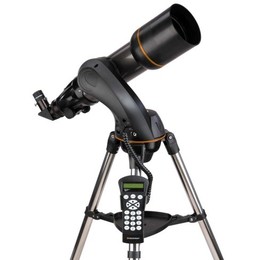
PictureFigure 1.1: A Celestron Nextstar 102 SLT (Image Credit: https://www.astronomics.com/images/Product/large/8780.jpg)

Introduction

                In 2014, the university has finally received a tool that would finally enable the Department of Earth and Space Science to conduct astronomical spectroscopy, albeit at the amateur level. This tool is the Rainbow Optics Star Spectroscope. Acquiring it is a small step for research but a huge leap for the department. This research aims to serve as a trailblazer for the department that would inspire the present and future batches of students to conduct research that involves stellar spectroscopy.
Statement of the Problem
                The researcher aims to determine the chemical composition of the mentioned stars using the tools of the Department of Earth and Space Science.


Scope and Limitation

                Being more interested in theoretical astrophysics, the researcher hasn’t done any astronomy research that involves telescopes and various instruments; a clear indication of inexperience and unfamiliarity with observational methods. He also possesses severe eye problems, nearsightedness and astigmatism with a vision of around 1300/800, compared to the normal 20/20. This would mean that the researcher would have huge difficulty in using optical instruments. Assistance of someone, who has experience in observational research and has used the spectroscope previously, was requested. Most importantly, since the department as a whole is new to spectroscopy, effective methods for capturing the perfect spectrum were not known aside from taking
them at clear skies. This would have a profound effect on the quality of data gathered. Lastly, a DSLR was used instead of CCDs that are much more preferable in amateur spectroscopy.

Data Gathering and Procedures

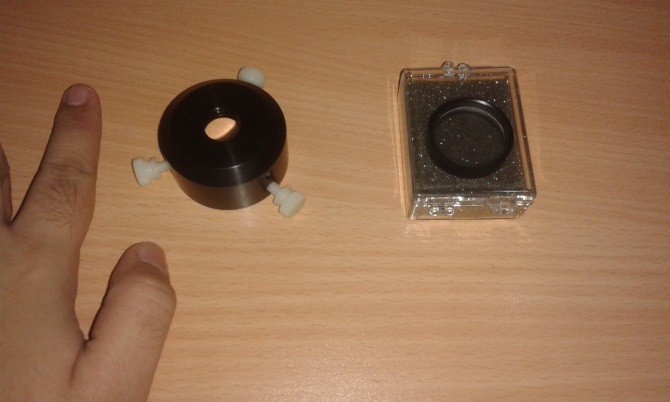
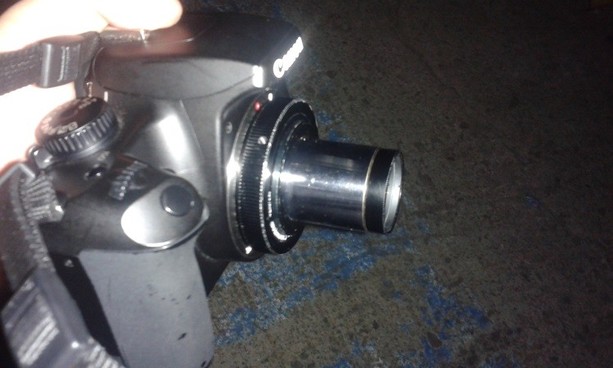
                Among the armada of telescopes that the department possesses, the Celestron Nextstar 102 SLT, but with a German-Equatorial mount was used due to its portability. The DSLR of the department, Canon EOS 1000D, with the rainbow optics star spectroscope attached through a t-adapter, was used. The researcher was fortunate enough to be assisted by Paulo de Mesa and mainly, Jonah Inguito in March 7 and 12 respectively. The data that were used in this research were from the ones gathered during March 12. An efficient and easy to learn spectroscopy software, RSpec(30-day trial), was used to interpret the gathered data. Fortunately, the website of RSpec has made a lot of tutorial videos that would brief its new users in a short span of time.
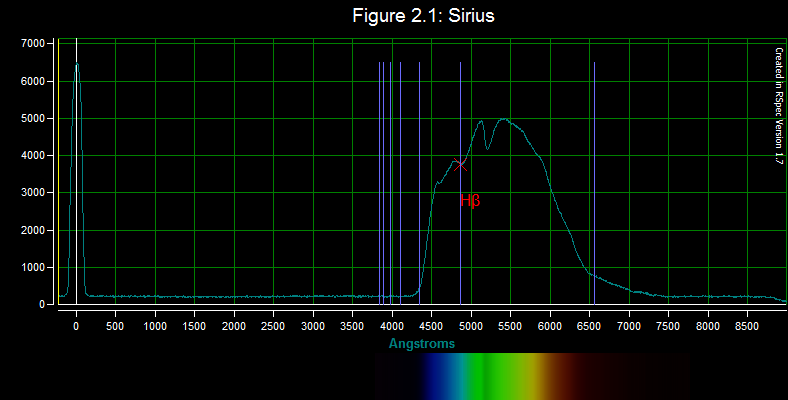
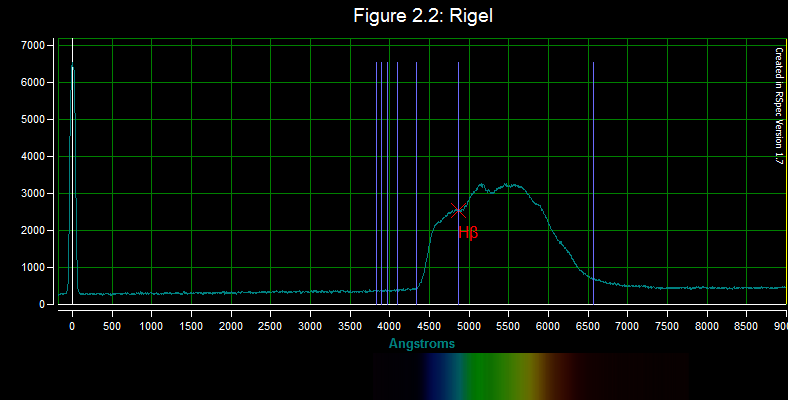
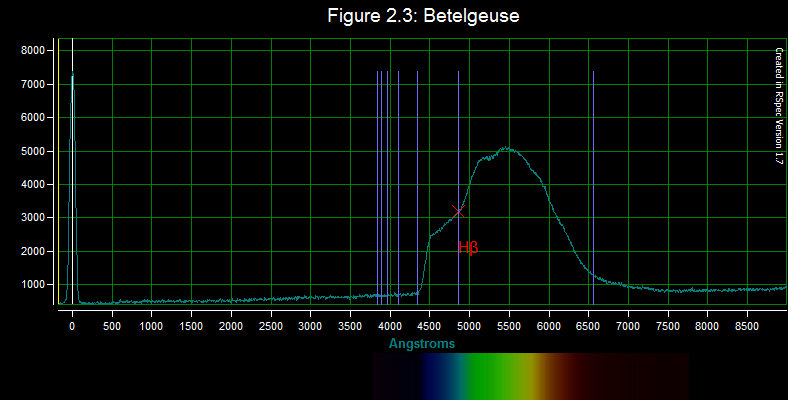
                The stars chosen were αCMa, α Ori and β Ori; Sirius, Betelgeuse and Rigel respectively due to their apparent magnitudes and their proximity due to each other during the Month of March and visibility during 7 pm to 11 pm. Exposure of 1 sec and ISO 200 for Sirius and Rigel and ISO 400 for Betelgeuse were the settings utilized.


Picture
Figure 1.2: Lens Cell (Left) and Diffracting Cell (Right)
Picture
Figure 1.3: DSLR with the Diffracting Cell Attached
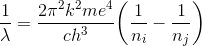
It is fruitless to study spectroscopy without understanding the quantum mechanics behind spectroscopy. Balmer’s formula is used to find where the lines of the Balmer series for Hydrogen reside in the spectrum. Stars are made primarily of Hydrogen and therefore the lines are expected to be easily seen. Balmer’s formula is:
Picture
Picture
Picture
Picture
The Hβ of Sirius was indeed visible while those of Betelgeuse and Rigel were hardly seen. Hydrogen was the only element that was detected and the metallicity of the stars was not determined. It could be concluded that the data gathered was not sufficient to accurately describe the composition of the stars and differentiate them from each other.

References
http://www.rspec-astro.com
http://www.rspec-astro.com/more-videos/
http://www.starspectroscope.com/


Acknowledgement

                The researcher would like to thank the following for their invaluable help that made this research possible:

                 Jonah Inguito, for the invaluable assistance during March 12 at the gathering of data and for lending his experience at using the Star Spectroscope.

                  Paulo de Mesa, for the assistance during March 7. Prof. Pauline Divinagracia and Prof. Miguel Artificio, for allowing the researcher to use the department’s equipment and providing the grounds for the observation.

                   Mr. Tom Field of RSpec, for creating such innovative software, accompanying tutorials and assistance when the researcher had a problem installing the software.


0 Comments

Sunspot in Relation to CME and its Intrinsic Properties Using Solar and Heliospheric Observatory Data

1/26/2015

0 Comments

 
The study presented the archived data of Coronal Mass Ejection (CME) together with its intrinsic properties and Smooth Sunspot Number (SSN) that both came from international science institutions which are the Solar Heliospheric Observatory and National Oceanic and Atmospheric Administration with the purpose of finding the relationship between the SSN and CME together with its properties. Also to determined the behavior of the two variables during solar maximum. With the data gathered the researcher will be able to conclude the relationship of the two.

The researcher used the descriptive method in this study, to determine the relationship of SSN and CME with its intrinsic properties such as width, frequency, initial and final velocity and acceleration. This method enabled the researcher to establish if this relationship exists. The research materials that were used in this study were the archived data from National Oceanic and Atmospheric Administration (NOAA) for Smooth Sunspot Data and for the CME Data came from Solar Heliospheric Observatory (SOHO). The archived data ranges from the year 1996-2012.


By: Princess B. Tucio


0 Comments

Limiting Visual Magnitude of Gemini and Auriga in Residential and Urban Areas of Rizal

1/26/2015

0 Comments


This study aims to know the Limiting Visual Magnitude of Residential Urban Areas in Rizal using the star count method and predetermined star fields (Gemini and Auriga) of International Meteor Organization.The International Meteor Organization (IMO), a non-profit organization based in Belgium and committed to the amateur study of meteors, prescribes probably the most comprehensive of the many published star count methods. The observations were made in moonless night time, no cloud formation, and clear sky condition.

The locations were the actual observations was made are far at the center, high altitudes, and in dark open areas. Using the different Limiting Visual Magnitude it shows the relationship with the Population Density of were the observations was made. This study showed Population Density is inversely related to Limiting Visual Magnitude. The correlation of Gemini, Auriga and Population Density has a strong negative relationship. The relationship is negative; as the Population Density increases, the Limiting Visual Magnitude decreases. The relationship between Limiting Visual Magnitude of Gemini, Auriga and Population Density is statistically significant.The study showed that the South West part of Rizal received the most effect of the light pollution. Among the Residential Urban Area in the Municipalities, the Brgy. San Isidro of Angono is the most affected light pollution coming from Metro Manila and its surrounding communities. The Southwest of Rizal has a Mild Light Pollution and the Eastern Rizal has Dark Sky with less Light Pollution. Barangay Quisao of Pililla had the highest value of Limiting Visual Magnitude. Based on the value of Limiting Visual Magnitude, Barangay Quisao of Pililla had the darkest sky. The Limiting Visual Magnitude has significant effect to the quality of the night sky. The value for the Standard Deviation of Gemini is 0.223052 and for Auriga is 0.481217. The highest value Limiting Visual Magnitude of Gemini is 6.3, Auriga 6.1 on Pililla, second Gemini 6.1, Auriga 5.9 on Jalajala. Given the Standard Deviation of Gemini and Auriga it shows the value of Limiting Visual Magnitude on Gemini and Auriga of Pililla has a significant difference on the value of Jalajala.

by: Rose Ann B. Bautista


0 Comments

Sunspot Activity In Terms of the Wolf Number for February 2014

6/19/2014

0 Comments

 
Aldrin Gabuya | Observational Astronomy Project
AAVSO Newsletter, Issue No. 60 April 2014
0 Comments

Sunspot Data Extraction Using 3D Isophote Rendering

5/10/2014

0 Comments

 
Reuel Norman A. Marigza, Jr.
Solar Observation Program
May 2014

Abstract
The paper explores the use of three-dimensional isophote rendering from ImageJ to
be used to analyze sunspot groups and extract sunspot count data and structural
features. This technique allows increased accuracy in acquiring the Wolf number
even with the use of low-resolution image data.

0 Comments

Solar Flare and Sunspot Group Analysis of Solar Maxima 2013 for Solar Cycle 24

2/19/2014

0 Comments

 
Marigza, R. N., Angeles, X. F., Delda, J. A., and Garrido, V. G.

The paper characterizes the solar maximum 2013 for the solar cycle 24 in terms of the analysis of X-ray solar flares and sunspot groupings. This study analyzes sunspot groups and corresponding flare rates for the year 2013 against historical flare rates and class frequencies.

0 Comments

Instrumentation for Mars Observation, 2003 to 2004

7/11/2013

0 Comments

 
Academic Journal
Dr. Jesus Rodrigo F. Torres

Abstract

RATIONALE
Mars was in opposition in 2003 in its closest approach to Earth in more than 50,000 years. Astronomers all over the world took this occasion to observe Mars with all types of Earth-bound telescopes. I used the Orion XT-10 Newtonian reflector to do my observations. However, to maximize its use for high-power observing, modifications in the altazimuth motion and in the sighting mechanism of the telescope had to be made. The improvements resulted into smooth altazimuth telescope motion and faster sighting of objects to be observed. The telescope has been very useful for deep-sky observing up to this day.

OBJECTIVES
The purpose of this study is to observe Mars during its best opposition in 2003, record the observations using astronomical sketching, identify the features of Mars as revealed in the sketches, compare the sketches with the images of Mars on the time and dates of observation; and find out the best configuration for the Orion SkyQuest 10-inch Newtonian Reflector telescope.

METHODOLOGY
Experimentation in the most effective configuration and modification of the telescope is done after initial assessment of its usefulness. The actual field observations were conducted whenever weather and sky conditions allowed. Sketching of the planet Mars was done for several hours every observing session. Features of the planet were revealed only after patient waiting for the atmosphere to allow the seeing. And lastly the features of the planet revealed in the sketch were then compared with the planet’s actual features on the date and time of observation by using the Celestia and Stellarium softwares.

RESULTS
Sketches of the planet Mars using the modified Orion XT-10 Newtonian reflector were compared side by side with the images of Mars on the exact time and date of the observation when the sketches were made. The sketches have differences with the actual images. This means that the human eye can sometimes perceive features in astronomical objects which images cannot capture accurately. Sketches, therefore, are real scientific records which may be used as baseline data for future studies of the same object.

CONCLUSIONS
Newtonian reflectors on Dobsonian mounts can be configured to be highly efficient instruments for serious astronomical visual observing with sketching as the preferred method for recording the observations; Planetary observers should monitor the events on the planets particularly the best times to observe them; Students of astronomy or Earth Science should be taught how to sketch through whatever telescopes are available; Sketches and images are fine records of the objects observed, the weather and sky condition during the night of observing, the instruments used, the magnification and similar data; The modified telescope needed no more upgrading and I still use it today for observations of deep-sky objects such as galaxies, planetary nebulae, globular clusters, open clusters, and supernova remnants. It is especially good for observing faint objects. Tracking remains smooth after more than a decade of use.

KEYWORDS Astronomy Education, Astronomical Observation, Astronomy Instrumentation


0 Comments

Urban Astronomy in the Philippines Volume 5 (2003)

7/7/2013

0 Comments

 
Academic Journal
Dr. Jesus Rodrigo F. Torres

Abstract
In this Volume I have observed and described 5 planetary nebulae, 3 asterisms, 1 variable star, Saturn
and five of its moons (several times have I observed these), 4 bright nebulae, galaxies, 3 globular
clusters, 50 open clusters, 30 double and multiple stars, and 41 single stars. I am reaching deeper into
the sky, for the first time there are more deep-sky objects than single stars in a single volume.

0 Comments

Urban Astronomy in the Philippines Volume 4

7/7/2013

0 Comments

 
Academic Journal
Dr. Jesus Rodrigo F. Torres

Abstract
URBAN ASTRONOMY FROM TWO CITIES: A COMPARATIVE ANALYSIS
The April, 2002 issue of Sky and Telescope contains an article entitled URBAN
ASTRONOMY: Observing the Messier Objects from the City. Since I have been writing observation
reports about Urban Astronomy, I decided to compare my findings with those of Tony Flanders, the
author of the article.

0 Comments

Urban Astronomy in the Philippines Volume 17

7/7/2013

0 Comments

 
Academic Journal
Dr. Jesus Rodrigo F. Torres

Abstract
Included in this Volume are eighteen deep-sky objects. Among those catalogued, 9 are open clusters, 4
are galaxies, 2 are planetary nebulae, 1 is a globular cluster, 1 is an emission nebula, and 1 is a
supernova remnant. Out of the eighteen objects catalogued, eight are Caldwell objects.
There are now images taken by one superb Filipino astronomer and astrophotographer, John Nassr. The
number of images per object has increased because of the request of some readers. They want to see
more images of the objects described. I also tried to get more than one locator map per object to make
searching for the objects easier for those who do not have GOTO telescopes.

0 Comments
<<Previous

    Research and Publication

    Here is a listing of researches and publications conducted by RTU-ESS.

    Archives

    December 2015
    January 2015
    June 2014
    May 2014
    February 2014
    July 2013
    May 2013
    March 2013
    July 2012
    March 2012
    November 2011
    July 2011
    March 2011
    July 2009
    October 2008
    July 2007
    July 2006
    July 2005
    September 2004
    July 2003
    July 2001
    July 2000

    Categories

    All
    Astronomy And Meteorology
    Astronomy Education
    Astronomy Instrumentation
    Light Pollution Studies
    Observational Astronomy
    Solar Astronomy
    Space Science

    RSS Feed

COPYRIGHT 2012 Created By: ESison
Powered by Create your own unique website with customizable templates.